

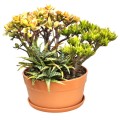
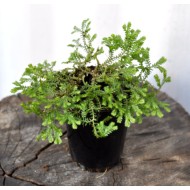
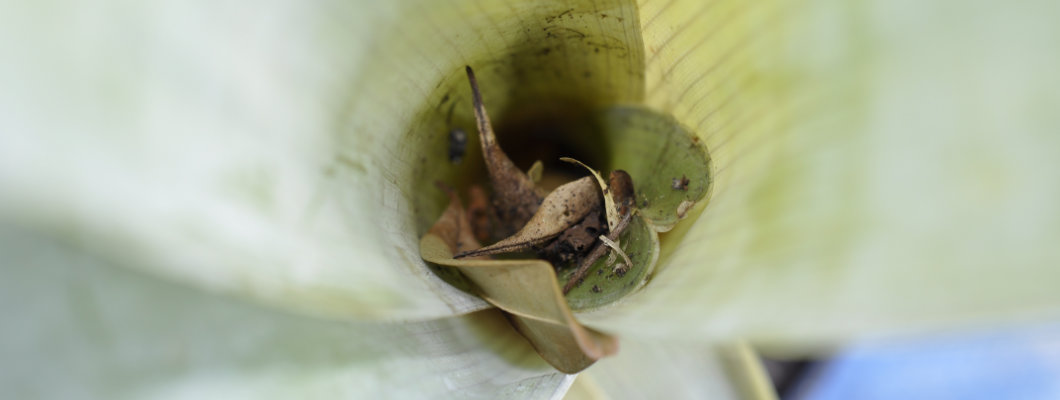
Title image above is copyright © Kristi Ellinopoullos
First published 10th December 2025
Did you know that there are carnivorous bromeliads? Not too many, only three or four in the entire Bromeliaceae (Bromeliad) family of roughly 80 genera and 3,700 species. (How I would love them to all be here with me!).
I say “three or four” as there is some debate in the botanical world as to which qualify as true carnivorous plants.
Of those three or four, all but one are in the genus Brocchinia: Brocchinia reducta, Brocchinia hechtioides, and Brocchinia tatei. B. tatei is the most disputed of these. Catopsis berteroniana is the sole member of the Catopsis genus thought to also be carnivorous.
The reason for the contention appears to be due to the nature of bromeliads in general. Many bromeliads, such as the matchstick bromeliad (Aechmea gamosepala) or Vriesea philippocoburgii are epiphytic. This means they live on trees, but without harming the host tree in any way. These epiphytic bromeliads use their roots to anchor themselves to branches rather than for water and nutrient uptake.
Many epiphytic bromeliads instead form ‘cups’ or ‘vases’ with their leaves with which to collect and hold water and leaf and other debris. This debris feeds the plant as it breaks down in the cup/vase. These types of bromeliads are also known as ‘tank bromeliads’.
The debate centres around at which point does a bromeliad truly become carnivorous, if it is already breaking down organic matter in its tank, as such debris does include insects as well as leaves and twigs. Were the insects already dead when they fell into the tank? Did they fall into the tank with any leaf matter they happened to be on, to then drown in the tank water? Or where they lured into the cup by the bromeliad?
In other words, for a plant to be truly carnivorous, it must be both luring and trapping insects for the specific reason of obtaining nutrients from them (‘eating’ them).
This trapping of insects is without dispute for well-known carnivorous plants such as the Venus flytrap (Dionaea muscipula), the tropical pitcher plants/monkey cups (Nepenthes spp.), or the North American pitcher plants (Sarracenia spp.) All of these have evolved incredible traps for the sole purpose of both luring and retaining insects. So dedicated that they flower in a way that ensures wanted pollinators don’t enter those traps!
So, knowing this, it becomes understandable that these bromeliad species are debated as to whether truly carnivorous or not.
This is Brocchinia reducta (complete with little sundew friends!), and it is native to the table-top mountains/mesas (tepuis) of Venezuela, Guyana, Brazil, and Colombia:
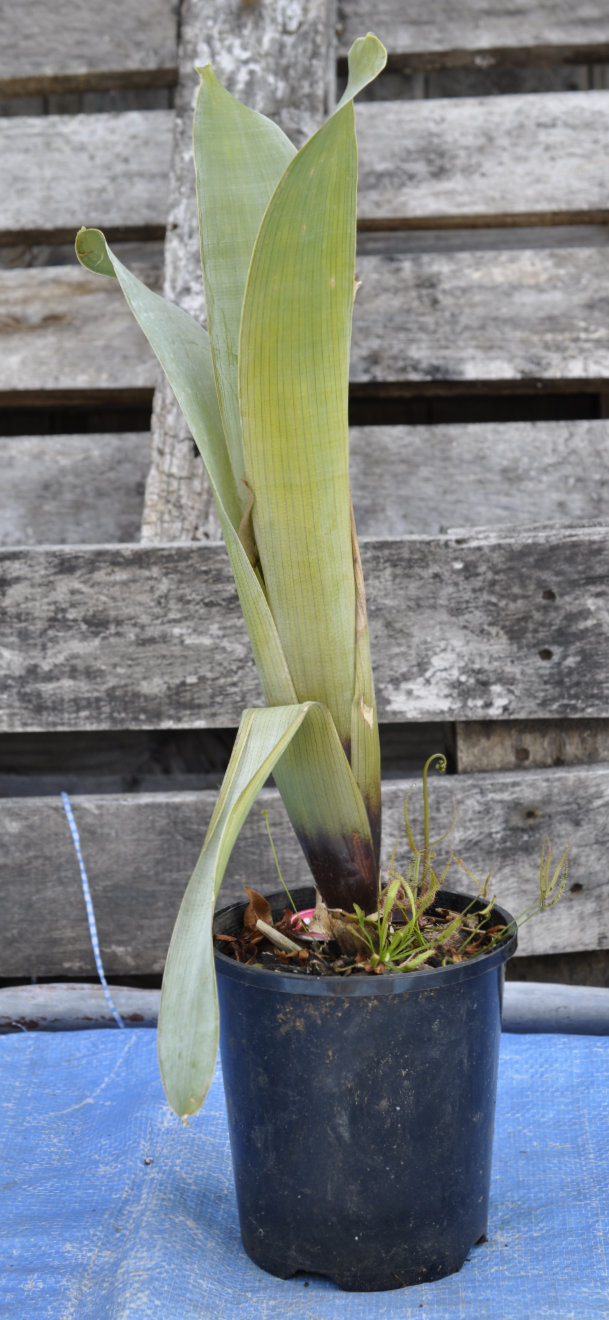
copyright © Kristi Ellinopoullos
The area is nutrient-poor and B. reducta is known to grow on rocks by using its roots as anchors.
Certainly Brocchinia reducta ticks quite a few boxes in my eyes to qualify as a true carnivorous plant. These being:
- the inner cylinder formed by the leaves is coated with a slippery wax which insects cannot overcome to climb out
- insects are attracted to this wax as it reflects UV
- the ‘tank’ of B. reducta not only has an insect-attracting odour, but also secretes a digestive enzyme into the collected water
- the leaves are covered in trichones (tiny ‘hairs’) able to absorb nutrient molecules as small as 6.6 nm (0.0000066 mm)

Leave a Comment